
Abijith Barthur | 0
MBBR is Not “Plastic”: Why Process Engineering Must Drive Media Selection
21 Feb, 2026
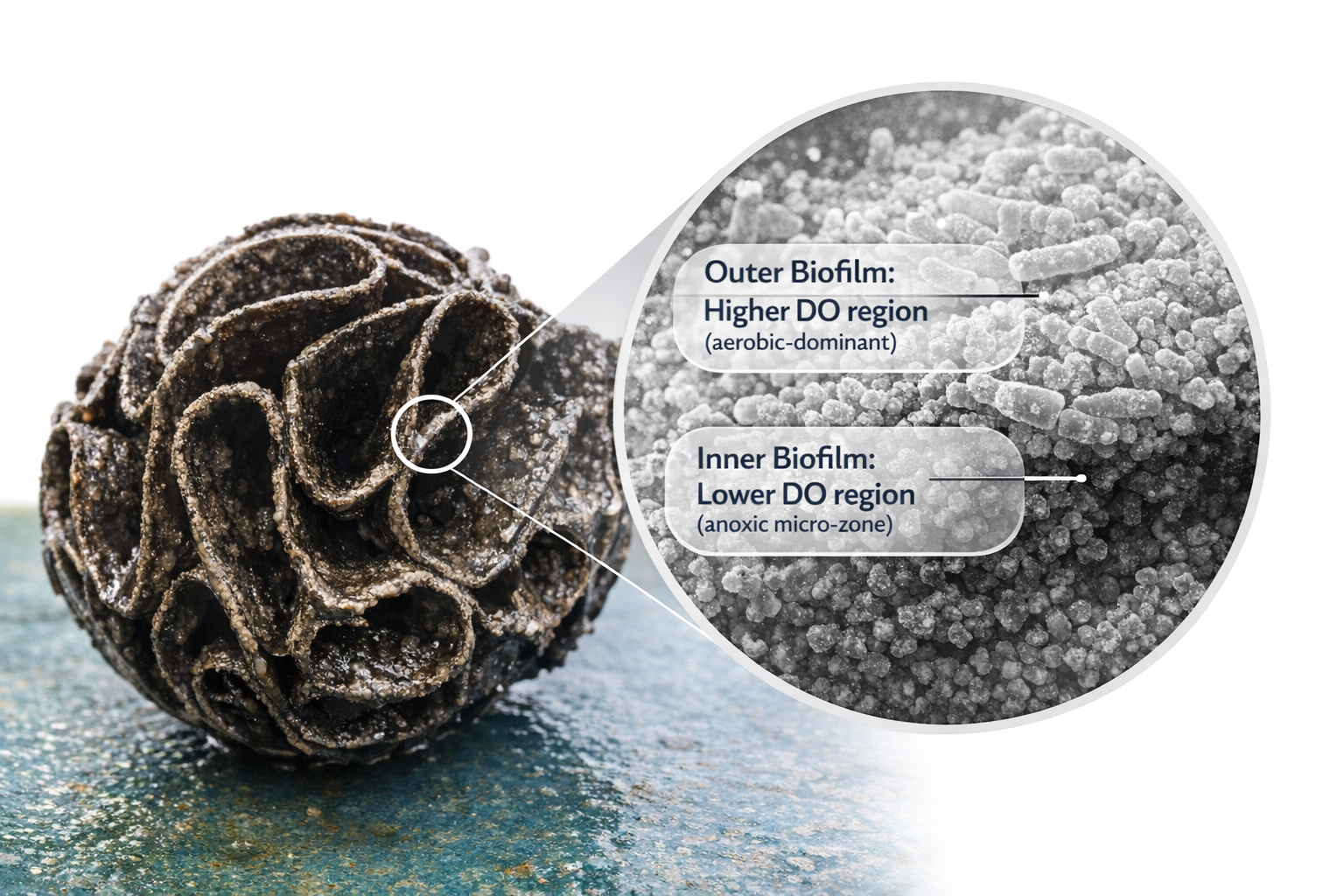
What Every Buyer Should Ask Before Selecting MBBR Media?
1. Is this media being sold as plastic — or as process technology?
2. Is the discussion on
a. Surface Area and Specific Surface Area?
b. Specific gravity
c. Media Price per m3
d. 25% - 40% fill fraction
e. Shape of media
f. Size of Media
If any or all of the above is true! Beware! Warning Sign!
3. What do MBBR carriers influence
a. Biomass retention
b. Biofilm thickness
c. Oxygen diffusion
d. Sloughing
e. Detachment cycles
f. Entrapment rates
g. Low DO performance
The media effectively defines micro-reactor environment in which biology survives. In theory, the carrier is a “Reactor”
4. When selecting biofilm carriers, you need to check
a. Active biofilm concentration
b. Entrapment rates
c. Performance in Low DO environments
d. Oxygen mass transfer vs biofilm depth
e. Sloughing rate
The real design parameter is the active biomass supported per unit carrier volume.
5. Traditional loading values of 8-12 g BOD/m2-day we developed under
a. Older carrier geometrics
b. Limited entrapment structures
c. Lower void designs
Modern engineered carriers such as Scogen’s BioSwirl media can sustain significantly higher loads – such as 30-55 g/m2-day.
This is possible due to:
a. High entrapment efficiency
b. Controlled biofilm thickness due to high sloughing
c. Increasing performance of each carrier with stratified biomass
This results in:
1. Reduced media volume
2. Smaller reactor footprints
3. Lower lifecycle cost of the plant
4. More efficient biological performance
5. Lower aeration energy demand
6. Stable nitrification and denitrification
7. Sustained biological activity at reduced DO
Finally, attached growth process requires process engineers and technocrats, not just moulded carriers. MBBR is not a plastic supply contract.
Publisher: Abijith Barthur | 0